
Batch Translate SRT Subtitles
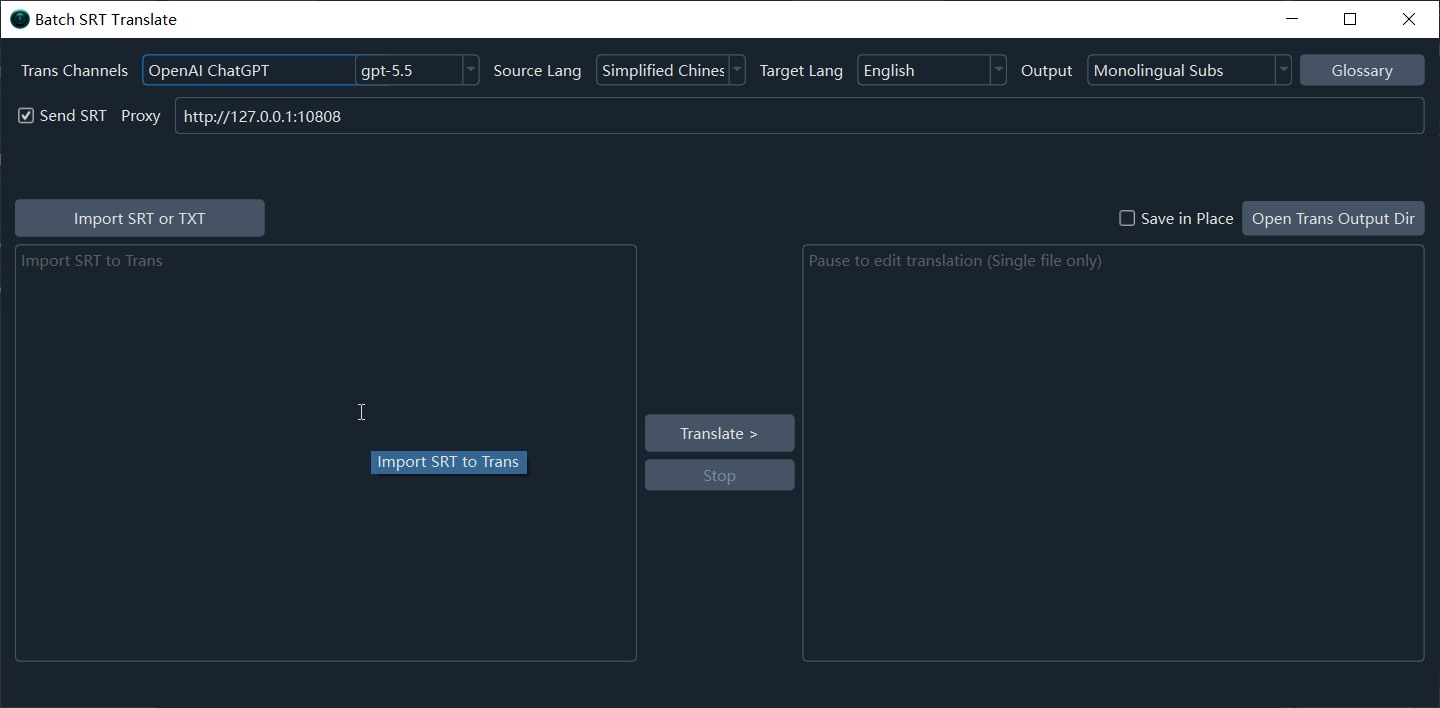
The batch SRT translation feature lets you translate existing SRT subtitle files into a target language while preserving the original timeline and formatting.
Overview
- Batch-translate multiple SRT subtitle files
- Auto-detect source language (or specify manually)
- Monolingual and bilingual output
- Translation glossary support
- Send full subtitle to AI for better context
Steps
1. Select Translation Channel
Choose a translation engine from the Trans Channel dropdown.
2. Select Languages
- Spoken Lang: The language of the subtitle file (auto-detected by default)
- Target Lang: The language you want to translate into
3. Output Format
| Option | Description |
|---|---|
| Monolingual subtitles | Output only the target language |
| Bilingual subtitles | Output both the original and translated text |
4. Other Settings
| Parameter | Description |
|---|---|
| Translation glossary | Custom terminology translations |
| Send full subtitle | Include timeline when translating with AI (recommended) |
| Network proxy | Set this if you need a proxy to access the internet |
5. Import Method
- Import Source SRT: Select one or more SRT files
- Folder: Select a folder containing SRT files
- Overwrite current: Replace the current editor content after import
6. Start Translation
Click Start to begin. Translations are saved automatically when complete.
Save options: You can choose "Overwrite" (modify the original file directly) or "Save to..." (save to a new location).
FAQ
Q: Translation results are inaccurate?
- Try switching the translation channel (e.g., from Google to DeepSeek)
- Enable Send SRT so the AI can see the full context
Q: Timeline is offset after translation?
- SRT translation normally preserves the original timeline
- If the timeline is off, the original SRT file may have formatting issues