When AI Dubbing Meets Video: An Automated Engineering Practice for Achieving Audio-Visual Synchronization
Dubbing videos from one language into another has become increasingly common. Whether it's for knowledge sharing, film and television works, or product introductions, good localized dubbing can significantly bridge the gap with the audience. However, a persistent, tricky problem lies behind this: how to achieve audio-visual synchronization?
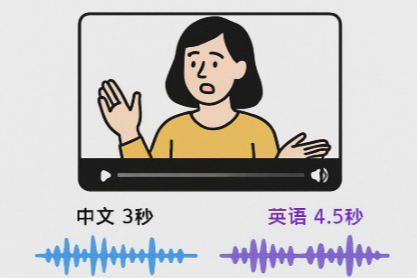
Linguistic differences are inherent. A 3-second Chinese dialogue might take 4.5 seconds to say in English, and 5 seconds in German. Even within the same language, different TTS (Text-to-Speech) engines, different voices, or even the same voice with different emotions can generate speech of varying lengths.
This mismatch in duration directly leads to a disconnect between the sound and the speaker on screen. When the audience sees a person's mouth close while the voice continues, the resulting sense of disconnection is devastating.
Manually aligning each line of dubbing can achieve perfection, of course. But facing a video with hundreds or thousands of subtitles, possibly with many more videos waiting to be processed, this is nothing short of a tedious and time-consuming nightmare. We need an automated solution.
This article shares the exploration process of such an automated solution. It uses Python, leveraging the powerful ffmpeg and pydub libraries, to find an acceptable synchronization point between the translated dubbing and the original video. It does not pursue pixel-perfect alignment but aims to build a robust, reliable, and automatically executable engineering workflow. In most cases, this process can generate a video that sounds and looks natural enough.
Core Idea: Finding Balance Between Audio and Video
The root of the problem is the time difference. Trouble arises when the dubbing duration exceeds the video duration corresponding to the original subtitle. We need a way to "create" extra time out of thin air.
This challenge only appears when the dubbing is too long. If the dubbing is shorter than the video, at worst, the character finishes speaking early while the mouth is still moving. This is relatively acceptable in terms of viewing experience and doesn't disrupt the subsequent timeline. However, dubbing that is too long encroaches on the playback time of the next line, causing overlapping speech or a complete misalignment of the entire timeline. This is the core contradiction we must solve.
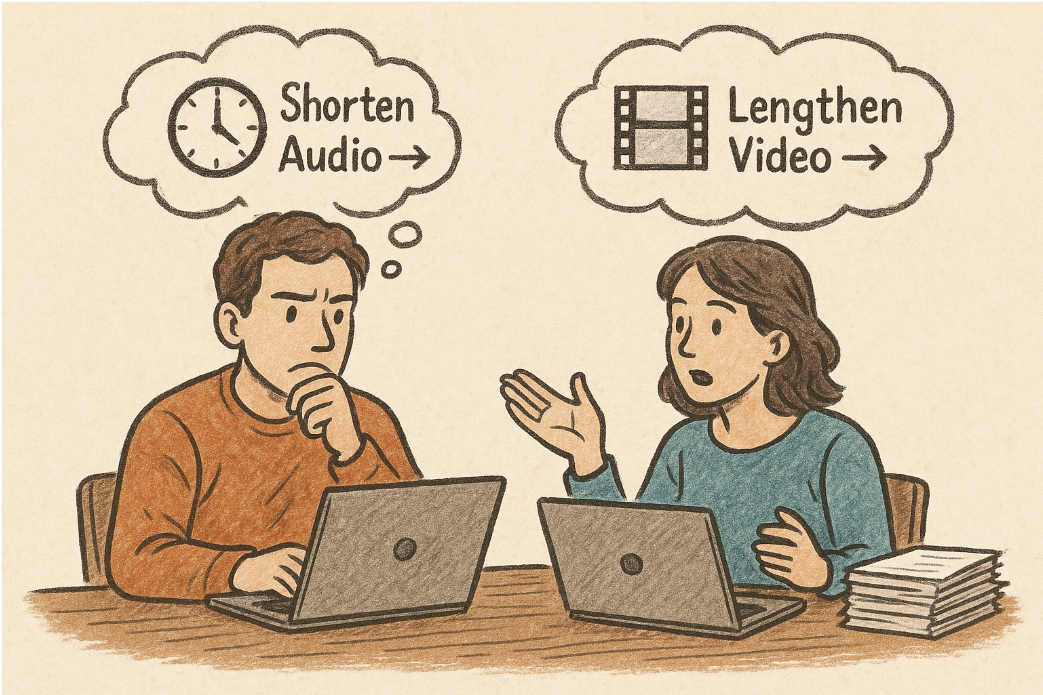
There are essentially two approaches: either shorten the audio or lengthen the video.
- Shortening the audio means speeding it up. Python's
pydublibrary provides aspeedupmethod, which is simple to implement. But its drawback is obvious. When the speedup ratio exceeds 1.5x, the voice starts to distort, the speech rate becomes too fast, and it sounds unnatural. Exceeding 2x, the dubbing largely loses its ability to convey information meaningfully. - Lengthening the video means slowing it down.
ffmpeg'ssetptsfilter is a powerful tool for this purpose. A single command likesetpts=2.0*PTScan double the duration of a video clip smoothly. This buys us precious time. But similarly, excessive slowdown makes the characters' movements appear in "slow motion," seeming sluggish and unnatural.
A good automated strategy must find a balance between these two. Our initial idea was simple:
- If the time difference is small, say less than 1 second, let the audio bear this slight pressure alone. Minor speedup is usually imperceptible to the human ear.
- If the time difference is larger, then both audio and video should share the burden. For example, each could be responsible for half of the extra time. Speed up the audio a bit, slow down the video a bit, minimizing distortion on both sides.
This idea formed the cornerstone of our solution. But when we actually started writing code, we realized that engineering implementation was far more complex than imagined.
First Attempt: A Fragile Loop and Intertwined Logic
The most intuitive approach is to iterate through each subtitle. Within the loop, get the dubbing duration, compare it with the original duration. If the dubbing is too long, decide on the spot whether to speed up the audio or slow down the video, then immediately execute the ffmpeg or pydub command.
This approach seems straightforward but hides significant risks. It couples operations of entirely different natures—"calculation/decision," "file I/O," and "state updates"—all within one big loop.
This means that if any single link in the loop fails—for example, if a video clip fails to process due to a minor ffmpeg issue—the entire process could be interrupted. Even if it doesn't crash, subsequent iterations might produce unpredictable errors due to corrupted state.
A more robust architecture must decouple the process, splitting it into several independent, atomic stages.
- Preparation Stage: First, go through all subtitles completely, doing only one thing: collecting information. Calculate and store the original start/end times, original duration, dubbing duration, and the duration of the "silent gap" between it and the next subtitle for each line.
- Decision Stage: Go through again, this time only performing calculations and making decisions. Based on our defined balancing strategy, calculate the final "target audio duration" and "target video duration" for each subtitle that needs adjustment. This stage does not modify any files.
- Execution Stage: With a clear "blueprint," we can now start working. Based on the results from the decision stage, process all audio and video files in batches, potentially even in parallel. Audio speedup and video processing can be executed separately.
- Merging Stage: After all independent audio/video clips have been processed, the final step is to concatenate them in the correct order to generate the final file.

Making each part's function single-purpose results in clearer code and easier error handling and debugging. This is the first step from "usable" to "reliable."
The Silent Enemy: Absorbed Gaps and Error Elimination
The video timeline is continuous. There are often "silent gaps" of a few seconds without dialogue between subtitles. These gaps are part of the video's narrative rhythm; mishandling them makes the entire piece feel strange.
A natural idea is to treat gaps as special clips to be processed. If there's a 2-second gap after subtitle A ends and before subtitle B starts, we should also cut out that 2-second segment of video.
But this introduces a new problem: what if this gap is extremely short, say only 30 milliseconds?
ffmpeg behaves very unpredictably when processing such extremely short segments. Video is composed of frames, each typically lasting between 16ms to 42ms (corresponding to 60FPS to 24FPS). You cannot make ffmpeg precisely cut a segment of only 30ms, as it might be less than one frame. Forcing it will likely result in command failure or generate an empty 0-byte file.
Our initial thought was to "discard" them. If a gap is too short, say less than 50 milliseconds, we simply ignore it. But we quickly rejected this idea ourselves. A long video might have hundreds or thousands of such tiny gaps. Discarding a frame or two each time accumulates, causing a noticeable "jumpiness" or lack of smoothness in the video. This experience is unacceptable.
A better strategy is "absorption."
After processing a subtitle segment, we look ahead at the gap following it. If this gap is very short (below our set threshold of 50ms), we "absorb" this tiny gap, treating it as part of the current subtitle segment.
Example:
- Subtitle A:
00:10.000->00:12.500 - A 40ms tiny gap
- Subtitle B:
00:12.540->00:15.000
Following the "absorption" strategy, when processing subtitle A, we find the gap after it is only 40ms. Therefore, our cut endpoint is no longer 12.500, but extends directly to 12.540. Thus, this 40ms gap is seamlessly merged into the end of segment A.
This approach has two major benefits:
- Avoids Jumpiness: The video timeline remains continuous; no content is discarded.
- Provides Extra Buffer: The original duration of segment A increases from 2.5 seconds to 2.54 seconds. If this segment happens to need video slowdown, this extra 40ms provides a valuable buffer, allowing us to slightly reduce the slowdown ratio, making the visuals more natural.
The core of this strategy is dynamically adjusting the cut endpoint and meticulously maintaining the progression record of the entire timeline to ensure absorbed gaps are not processed again later.
Designed for Failure: A Resilient Processing Pipeline
Real-world media files are "dirtier" than we imagine. Videos might have slight codec errors at certain points, or an unreasonable slowdown parameter (like an extremely high slowdown ratio for an already short clip) could cause ffmpeg processing to fail. If our program crashes entirely due to the failure of one segment, it is a failure in engineering terms.
We must design for failure. Introduce a try-check-fallback mechanism in the video processing execution stage.
The process is as follows:
- Try: For a segment, execute the calculated
ffmpegcut command, which may include speed change parameters. - Check: Immediately after the command executes, check if the output file exists and its size is greater than 0.
- Fallback: If the check fails, a warning is logged. Then, the program immediately calls
ffmpegagain, but this time in safe mode—without any speed change parameters, cutting only at the original speed.
This fallback mechanism ensures that even if our slowdown operation on a segment fails, we can at least obtain a correctly timed original segment, preserving the integrity of the entire video timeline and preventing misalignment of all subsequent segments.
The Final Architecture: A Flexible, Decoupled SpeedRate Class
After repeated iterations and optimizations, a relatively robust SpeedRate class was formed. It encapsulates the entire complex synchronization process into a clear, reliable execution flow. Let's look at how its key parts work together.
import os
import shutil
import time
from pathlib import Path
import concurrent.futures

from pydub import AudioSegment
from pydub.exceptions import CouldntDecodeError

from videotrans.configure import config
from videotrans.util import tools

class SpeedRate:
    """
    Aligns translated dubbing with the original video timeline through audio speedup and video slowdown.

    V10 Changelog:
    - 【Strategy Optimization】 Introduced a "absorption" strategy for tiny gaps, replacing the original "discard" strategy.
      When the gap after a subtitle segment is below the threshold, it is absorbed into the preceding subtitle segment for processing,
      avoiding "jumpiness" and providing extra duration for video slowdown.
    - Adjusted the video_pts calculation logic accordingly to accommodate dynamically changing segment durations.
    """

    MIN_CLIP_DURATION_MS = 50  # Minimum valid clip duration (milliseconds)

    def __init__(self,
                 *,
                 queue_tts=None,
                 shoud_videorate=False,
                 shoud_audiorate=False,
                 uuid=None,
                 novoice_mp4=None,
                 raw_total_time=0,
                 noextname=None,
                 target_audio=None,
                 cache_folder=None
                 ):
        self.queue_tts = queue_tts
        self.shoud_videorate = shoud_videorate
        self.shoud_audiorate = shoud_audiorate
        self.uuid = uuid
        self.novoice_mp4_original = novoice_mp4
        self.novoice_mp4 = novoice_mp4
        self.raw_total_time = raw_total_time
        self.noextname = noextname
        self.target_audio = target_audio
        self.cache_folder = cache_folder if cache_folder else Path(f'{config.TEMP_DIR}/{str(uuid if uuid else time.time())}').as_posix()
        Path(self.cache_folder).mkdir(parents=True, exist_ok=True)

        self.max_audio_speed_rate = max(1.0, float(config.settings.get('audio_rate', 5.0)))
        self.max_video_pts_rate = max(1.0, float(config.settings.get('video_rate', 10.0)))

        config.logger.info(f"SpeedRate initialized for '{self.noextname}'. AudioRate: {self.shoud_audiorate}, VideoRate: {self.shoud_videorate}")
        config.logger.info(f"Config limits: MaxAudioSpeed={self.max_audio_speed_rate}, MaxVideoPTS={self.max_video_pts_rate}, MinClipDuration={self.MIN_CLIP_DURATION_MS}ms")

    def run(self):
        """Main execution function"""
        self._prepare_data()
        self._calculate_adjustments()
        self._execute_audio_speedup()
        self._execute_video_processing()
        merged_audio = self._recalculate_timeline_and_merge_audio()
        if merged_audio:
            self._finalize_audio(merged_audio)
        return self.queue_tts

    def _prepare_data(self):
        """Step 1: Prepare and initialize data."""
        tools.set_process(text="Preparing data...", uuid=self.uuid)

        # Phase 1: Initialize independent data
        for it in self.queue_tts:
            it['start_time_source'] = it['start_time']
            it['end_time_source'] = it['end_time']
            it['source_duration'] = it['end_time_source'] - it['start_time_source']
            it['dubb_time'] = int(tools.get_audio_time(it['filename']) * 1000) if tools.vail_file(it['filename']) else 0
            it['target_audio_duration'] = it['dubb_time']
            it['target_video_duration'] = it['source_duration']
            it['video_pts'] = 1.0

        # Phase 2: Calculate gaps
        for i, it in enumerate(self.queue_tts):
            if i < len(self.queue_tts) - 1:
                next_item = self.queue_tts[i + 1]
                it['silent_gap'] = next_item['start_time_source'] - it['end_time_source']
            else:
                it['silent_gap'] = self.raw_total_time - it['end_time_source']
            it['silent_gap'] = max(0, it['silent_gap'])

    def _calculate_adjustments(self):
        """Step 2: Calculate adjustment plans."""
        tools.set_process(text="Calculating adjustments...", uuid=self.uuid)
        for i, it in enumerate(self.queue_tts):

            if it['dubb_time'] > it['source_duration'] and tools.vail_file(it['filename']):
                try:
                    original_dubb_time = it['dubb_time']
                    _, new_dubb_length_ms = tools.remove_silence_from_file(
                        it['filename'], silence_threshold=-50.0, chunk_size=10, is_start=True)
                    it['dubb_time'] = new_dubb_length_ms
                    if original_dubb_time != it['dubb_time']:
                        config.logger.info(f"Removed silence from {Path(it['filename']).name}: duration reduced from {original_dubb_time}ms to {it['dubb_time']}ms.")
                except Exception as e:
                    config.logger.warning(f"Could not remove silence from {it['filename']}: {e}")

            # Available video duration may increase after absorbing tiny gaps
            effective_source_duration = it['source_duration']
            if it.get('silent_gap', 0) < self.MIN_CLIP_DURATION_MS:
                effective_source_duration += it['silent_gap']

            if it['dubb_time'] <= effective_source_duration or effective_source_duration <= 0:
                continue

            dub_duration = it['dubb_time']
            # Use effective duration for calculation
            source_duration = effective_source_duration
            silent_gap = it['silent_gap']
            over_time = dub_duration - source_duration

            # Decision logic now based on `effective_source_duration`
            if self.shoud_audiorate and not self.shoud_videorate:
                required_speed = dub_duration / source_duration
                if required_speed <= 1.5:
                    it['target_audio_duration'] = source_duration
                else:
                    # Note: silent_gap is actually 0 after absorption, but kept for logical completeness
                    available_time = source_duration + (silent_gap if silent_gap >= self.MIN_CLIP_DURATION_MS else 0)
                    duration_at_1_5x = dub_duration / 1.5
                    it['target_audio_duration'] = duration_at_1_5x if duration_at_1_5x <= available_time else available_time

            elif not self.shoud_audiorate and self.shoud_videorate:
                required_pts = dub_duration / source_duration
                if required_pts <= 1.5:
                    it['target_video_duration'] = dub_duration
                else:
                    available_time = source_duration + (silent_gap if silent_gap >= self.MIN_CLIP_DURATION_MS else 0)
                    duration_at_1_5x = source_duration * 1.5
                    it['target_video_duration'] = duration_at_1_5x if duration_at_1_5x <= available_time else available_time

            elif self.shoud_audiorate and self.shoud_videorate:
                if over_time <= 1000:
                    it['target_audio_duration'] = source_duration
                else:
                    adjustment_share = over_time // 2
                    it['target_audio_duration'] = dub_duration - adjustment_share
                    it['target_video_duration'] = source_duration + adjustment_share

            # Safety validation and PTS calculation
            if it['target_audio_duration'] < dub_duration:
                speed_ratio = dub_duration / it['target_audio_duration']
                if speed_ratio > self.max_audio_speed_rate: it['target_audio_duration'] = dub_duration / self.max_audio_speed_rate

            if it['target_video_duration'] > source_duration:
                pts_ratio = it['target_video_duration'] / source_duration
                if pts_ratio > self.max_video_pts_rate: it['target_video_duration'] = source_duration * self.max_video_pts_rate
                # pts needs to be calculated based on the final cut original video duration
                it['video_pts'] = max(1.0, it['target_video_duration'] / source_duration)

    def _process_single_audio(self, item):
        """Process a single audio file speedup task."""
        input_file_path = item['filename']
        target_duration_ms = int(item['target_duration_ms'])

        try:
            audio = AudioSegment.from_file(input_file_path)
            current_duration_ms = len(audio)

            if target_duration_ms <= 0 or current_duration_ms <= target_duration_ms: return input_file_path, current_duration_ms, ""

            speedup_ratio = current_duration_ms / target_duration_ms
            fast_audio = audio.speedup(playback_speed=speedup_ratio)
            config.logger.info(f'Audio speedup processing:{speedup_ratio=}')
            fast_audio.export(input_file_path, format=Path(input_file_path).suffix[1:])
            item['ref']['dubb_time'] = len(fast_audio)
            return input_file_path, len(fast_audio), ""
        except Exception as e:
            config.logger.error(f"Error processing audio {input_file_path}: {e}")
            return input_file_path, None, str(e)

    def _execute_audio_speedup(self):
        """Step 3: Execute audio speedup."""
        if not self.shoud_audiorate: return
        tasks = [
            {"filename": it['filename'], "target_duration_ms": it['target_audio_duration'], "ref": it}
            for it in self.queue_tts if it.get('dubb_time', 0) > it.get('target_audio_duration', 0) and tools.vail_file(it['filename'])
        ]
        if not tasks: return

        with concurrent.futures.ThreadPoolExecutor() as executor:
            futures = [executor.submit(self._process_single_audio, task) for task in tasks]
            for i, future in enumerate(concurrent.futures.as_completed(futures)):
                if config.exit_soft: executor.shutdown(wait=False, cancel_futures=True); return
                future.result()
                tools.set_process(text=f"Audio processing: {i + 1}/{len(tasks)}", uuid=self.uuid)

    def _execute_video_processing(self):
        """Step 4: Execute video cutting (using tiny gap absorption strategy)."""
        if not self.shoud_videorate or not self.novoice_mp4_original:
            return

        video_tasks = []
        processed_video_clips = []
        last_end_time = 0

        i = 0
        while i < len(self.queue_tts):
            it = self.queue_tts[i]

            # Process gap before the subtitle segment
            gap_before = it['start_time_source'] - last_end_time
            if gap_before > self.MIN_CLIP_DURATION_MS:
                clip_path = Path(f'{self.cache_folder}/{i:05d}_gap.mp4').as_posix()
                video_tasks.append({"ss": tools.ms_to_time_string(ms=last_end_time), "to": tools.ms_to_time_string(ms=it['start_time_source']), "source": self.novoice_mp4_original, "pts": 1.0, "out": clip_path})
                processed_video_clips.append(clip_path)

            # Determine the cut endpoint for the current subtitle segment
            start_ss = it['start_time_source']
            end_to = it['end_time_source']

            # V10 Core Logic: Look ahead to decide whether to absorb the next gap
            if i + 1 < len(self.queue_tts):
                next_it = self.queue_tts[i+1]
                gap_after = next_it['start_time_source'] - it['end_time_source']
                if 0 < gap_after < self.MIN_CLIP_DURATION_MS:
                    end_to = next_it['start_time_source'] # Extend cut endpoint
                    config.logger.info(f"Absorbing small gap ({gap_after}ms) after segment {i} into the clip.")

            current_clip_source_duration = end_to - start_ss

            # Create task only if the segment is valid
            if current_clip_source_duration > self.MIN_CLIP_DURATION_MS:
                clip_path = Path(f"{self.cache_folder}/{i:05d}_sub.mp4").as_posix()

                # If speed change is needed, pts may need recalculation
                pts_val = it.get('video_pts', 1.0)
                if pts_val > 1.01:
                    # new pts = target duration / new source duration
                    new_target_duration = it.get('target_video_duration', current_clip_source_duration)
                    pts_val = max(1.0, new_target_duration / current_clip_source_duration)

                video_tasks.append({"ss": tools.ms_to_time_string(ms=start_ss), "to": tools.ms_to_time_string(ms=end_to), "source": self.novoice_mp4_original, "pts": pts_val, "out": clip_path})
                processed_video_clips.append(clip_path)

            last_end_time = end_to
            i += 1

        # Process the final gap at the end
        if (final_gap := self.raw_total_time - last_end_time) > self.MIN_CLIP_DURATION_MS:
            clip_path = Path(f'{self.cache_folder}/zzzz_final_gap.mp4').as_posix()
            video_tasks.append({"ss": tools.ms_to_time_string(ms=last_end_time), "to": "", "source": self.novoice_mp4_original, "pts": 1.0, "out": clip_path})
            processed_video_clips.append(clip_path)

        # ... (Subsequent execution, merging logic remains the same as previous version) ...
        for j, task in enumerate(video_tasks):
            if config.exit_soft: return
            tools.set_process(text=f"Video processing: {j + 1}/{len(video_tasks)}", uuid=self.uuid)
            the_pts = task['pts'] if task.get('pts', 1.0) > 1.01 else ""
            config.logger.info(f'Video slowdown:{the_pts=}, processed output video segment={task["out"]}')
            tools.cut_from_video(ss=task['ss'], to=task['to'], source=task['source'], pts=the_pts, out=task['out'])

            output_path = Path(task['out'])
            if not output_path.exists() or output_path.stat().st_size == 0:
                config.logger.warning(f"Segment {task['out']} failed to generate (PTS={task.get('pts', 1.0)}). Fallback to original speed.")
                tools.cut_from_video(ss=task['ss'], to=task['to'], source=task['source'], pts="", out=task['out'])
                if not output_path.exists() or output_path.stat().st_size == 0:
                    config.logger.error(f"FATAL: Fallback for {task['out']} also failed. Segment will be MISSING.")

        valid_clips = [clip for clip in processed_video_clips if Path(clip).exists() and Path(clip).stat().st_size > 0]
        if not valid_clips:
            config.logger.warning("No valid video clips generated to merge. Skipping video merge.")
            self.novoice_mp4 = self.novoice_mp4_original
            return

        concat_txt_path = Path(f'{self.cache_folder}/concat_list.txt').as_posix()
        tools.create_concat_txt(valid_clips, concat_txt=concat_txt_path)

        merged_video_path = Path(f'{self.cache_folder}/merged_{self.noextname}.mp4').as_posix()
        tools.set_process(text="Merging video clips...", uuid=self.uuid)
        tools.concat_multi_mp4(out=merged_video_path, concat_txt=concat_txt_path)
        self.novoice_mp4 = merged_video_path

    def _recalculate_timeline_and_merge_audio(self):
        """Step 5: Recalculate timeline and merge audio."""
        merged_audio = AudioSegment.empty()

        video_was_processed = self.shoud_videorate and self.novoice_mp4_original and Path(self.novoice_mp4).name.startswith("merged_")

        if video_was_processed:
            config.logger.info("Building audio timeline based on processed video clips.")
            current_timeline_ms = 0
            try:
                sorted_clips = sorted([f for f in os.listdir(self.cache_folder) if f.endswith(".mp4") and ("_sub" in f or "_gap" in f)])
            except FileNotFoundError: return None

            for clip_filename in sorted_clips:
                clip_path = Path(f'{self.cache_folder}/{clip_filename}').as_posix()
                try:
                    if not (Path(clip_path).exists() and Path(clip_path).stat().st_size > 0): continue
                    clip_duration = tools.get_video_duration(clip_path)
                except Exception as e:
                    config.logger.warning(f"Could not get duration for clip {clip_path} (error: {e}). Skipping.")
                    continue

                if "_sub" in clip_filename:
                    index = int(clip_filename.split('_')[0])
                    it = self.queue_tts[index]
                    it['start_time'] = current_timeline_ms
                    segment = AudioSegment.from_file(it['filename']) if tools.vail_file(it['filename']) else AudioSegment.silent(duration=clip_duration)

                    if len(segment) > clip_duration: segment = segment[:clip_duration]
                    elif len(segment) < clip_duration: segment += AudioSegment.silent(duration=clip_duration - len(segment))

                    merged_audio += segment
                    it['end_time'] = current_timeline_ms + clip_duration
                    it['startraw'], it['endraw'] = tools.ms_to_time_string(ms=it['start_time']), tools.ms_to_time_string(ms=it['end_time'])

                else: # gap
                    merged_audio += AudioSegment.silent(duration=clip_duration)
                current_timeline_ms += clip_duration
        else:
            # Mode B logic here remains unchanged as it doesn't process video, so no gap absorption issue exists
            config.logger.info("Building audio timeline based on original timings (video not processed).")
            last_end_time = 0
            for i, it in enumerate(self.queue_tts):
                silence_duration = it['start_time_source'] - last_end_time
                if silence_duration > 0: merged_audio += AudioSegment.silent(duration=silence_duration)
                it['start_time'] = len(merged_audio)

                dubb_time = int(tools.get_audio_time(it['filename']) * 1000) if tools.vail_file(it['filename']) else it['source_duration']
                segment = AudioSegment.from_file(it['filename']) if tools.vail_file(it['filename']) else AudioSegment.silent(duration=dubb_time)

                if len(segment) > dubb_time: segment = segment[:dubb_time]
                elif len(segment) < dubb_time: segment += AudioSegment.silent(duration=dubb_time - len(segment))
                merged_audio += segment

                it['end_time'] = len(merged_audio)
                last_end_time = it['end_time_source']
                it['startraw'], it['endraw'] = tools.ms_to_time_string(ms=it['start_time']), tools.ms_to_time_string(ms=it['end_time'])

        return merged_audio

    def _export_audio(self, audio_segment, destination_path):
        """Export a Pydub AudioSegment to the specified path, handling different formats."""
        wavfile = Path(f'{self.cache_folder}/temp_{time.time_ns()}.wav').as_posix()
        try:
            audio_segment.export(wavfile, format="wav")
            ext = Path(destination_path).suffix.lower()
            if ext == '.wav':
                shutil.copy2(wavfile, destination_path)
            elif ext == '.m4a':
                tools.wav2m4a(wavfile, destination_path)
            else: # .mp3
                tools.runffmpeg(["-y", "-i", wavfile, "-ar", "48000", "-b:a", "192k", destination_path])
        finally:
            if Path(wavfile).exists():
                os.remove(wavfile)

    def _finalize_audio(self, merged_audio):
        """Step 6: Export and align final audio-video durations (only when video was processed)."""
        tools.set_process(text="Exporting and finalizing audio...", uuid=self.uuid)
        try:
            self._export_audio(merged_audio, self.target_audio)

            video_was_processed = self.shoud_videorate and self.novoice_mp4_original and Path(self.novoice_mp4).name.startswith("merged_")
            if not video_was_processed:
                config.logger.info("Skipping duration alignment as video was not processed.")
                return

            if not (tools.vail_file(self.novoice_mp4) and tools.vail_file(self.target_audio)):
                config.logger.warning("Final video or audio file not found, skipping duration alignment.")
                return

            video_duration_ms = tools.get_video_duration(self.novoice_mp4)
            audio_duration_ms = int(tools.get_audio_time(self.target_audio) * 1000)

            padding_needed = video_duration_ms - audio_duration_ms

            if padding_needed > 10:
                config.logger.info(f"Audio is shorter than video by {padding_needed}ms. Padding with silence.")
                final_audio_segment = AudioSegment.from_file(self.target_audio)
                final_audio_segment += AudioSegment.silent(duration=padding_needed)
                self._export_audio(final_audio_segment, self.target_audio)
            elif padding_needed < -10:
                 config.logger.warning(f"Final audio is longer than video by {-padding_needed}ms. This may cause sync issues.")

        except Exception as e:
            config.logger.error(f"Failed to export or finalize audio: {e}")
            raise RuntimeError(f"Failed to finalize audio: {e}")

config.logger.info("Final audio merged and aligned successfully.")Code Interpretation
__init__: Initializes all parameters and defines the key constantMIN_CLIP_DURATION_MS, which is the foundation for all our tiny segment processing strategies._prepare_data: Adopts a robust two-phase method to prepare data, completely solving potentialKeyErrorissues caused by "looking ahead" within a single loop._calculate_adjustments: The decision core. It first attempts to reduce pressure on subsequent processing by removing "fluff" (silence) from the beginning and end of the dubbing, then performs calculations based on our balancing strategy._execute_audio_speedup: Utilizes multi-threading to process all audio files requiring speedup in parallel, improving efficiency._execute_video_processing: This is the most complex part of the entire process and best embodies engineering practice. It implements the superior "absorption" strategy to ensure visual continuity while incorporating a "try-check-fallback" error tolerance mechanism, forming the cornerstone of the entire workflow's stability._recalculate_timeline_and_merge_audio: This method is designed very flexibly. It can automatically determine whether the video was actually processed and choose different modes to build the final audio timeline. This design allows the class to handle complex audio-video synchronization tasks as well as pure audio concatenation work._finalize_audio: The final "quality control" step. If the video was processed, it ensures the final generated audio track and video duration are completely identical—an essential detail in a professional workflow.
Usable, But Far From Perfect
Audio-visual synchronization, especially cross-language synchronization, is a field full of details and challenges. The automated solution proposed in this article is not the final destination and cannot completely replace the fine-tuning of professionals. Its value lies in the fact that, through a series of carefully designed engineering practices—logic decoupling, absorption strategy, error tolerance and fallback—we have built an automation workflow that is "smart" and "robust" enough. It can handle the vast majority of scenarios and gracefully navigate around pitfalls that would crash simpler scripts.
It is a product that achieves a practical balance between "perfect results" and "engineering feasibility." For scenarios requiring large-scale, rapid processing of video dubbing, it provides a reliable starting point, automating 80% of the work to generate an acceptable first draft. The remaining 20% can be left for manual final polishing.